Education
Slovenia offers a high-quality, well-structured education system that is welcoming to international families. Whether you are planning a short stay or a permanent move, there are excellent options in both the Slovenian and international school systems from pre-school to postgraduate study.
Education system in a nutshell
Education system in a nutshell
- Basic schools (osnovnošolsko izobraževanje)
- music schools (osnovno glasbeno izobraževanje)
- educational institutions for children with special educational needs.(izobraževanje oseb s posebnimi potrebami)
Secondary education (High School)
Upper secondary education (srednješolsko izobraževanje) refers to High Schools divided in two sections:
- vocational or technical high schools (specialised)
- Gimnazija high schools
Tertiary education (Higher Education)
- Higher post-secondary vocational education - Colleges (višješolsko strokovno izobraževanje)
- higher education – Faculties, academies and independent higher education institutions. (visokošolsko izobraževanje)
The school system in Slovenia is divided into three sections of education: primary, secondary and tertiary.
In Slovenia, education is primarily provided as a public service by state-funded institutions, as well as by private institutions and concession-holding providers delivering officially recognised or accredited programmes.
Public schools are legally secular and autonomous; political and religious activities are prohibited.
Preschool Education
Public
Preschool education (Predšolska vzgoja)is for children aged 11. months to 6. years or until children start compulsory primary education. It is not compulsory. A public network of kindergartens may be complemented by private kindergartens (holders of a concession).
Public kindergartens are founded by local communities, its programmes are funded by municipalities, payments by parents, and other sources (different subsidies apply).
Private vs. Public kindergarten
In Slovenia, kindergartens are either public or private (and international), and both follow the same national admission regulations.Monthly fees typically range from €300 to €790.
Public kindergarten
- Applications (typically) open mainly in March
- Children usually start in September
- Founded by municipalities
- Follow official national program
- Slovene language or minority language where applicable (Hungarian and Italian)
Private kindergarten
- Year-round enrollment in most cases
- Smaller group sizes
- In some cases, bilingual programs for Slovenian and international children
- May follow the national curriculum or offer alternative educational approaches such as Montessori, Waldorf, or Decroly.
- Usually more expensive, but some receive government subsidies
International Kindergartens
Kindergartens like Fridolin, La petite académie in Ljubljana and Forest kindergarten (Naši Mali Škratki) in Maribor and some other Montessori kindergartens in Ljubljana:
- can be subsidised by the government.
- offer multilingual environment in English, german and/or Slovene.
Kindergartens like Ljubljana International School (LIS), Leon Štukelj International School in Maribor, European International School:
- Fully international and private that are part of the pre-school international school curriculum.
- Offer international languages and have no subsidies option.
Excel of List of kindergarten
Home-based childcare
Preschool education may also be provided in the home of a preschool teacher or assistant employed by a kindergarten, or by a registered private preschool teacher. Private providers must meet the same qualification requirements as staff in public kindergartens and register with the Ministry of Education.
Childcare services may also be offered by qualified individuals who are not required to follow the kindergarten curriculum but must register with the Ministry to provide in-home care for up to six children.
Private and Public kindergartens of which 96 are Private kindergartens
(2025)
registered private home-based childcare
(2019)
Primary Education
Primary and Lower
Primary and lower secondary education (Osnovna šola) is organised in a single-structure 9- year basic school attended by students aged 6 to 15 years and is compulsory.
Official language in public primary school is Slovene and/or Italian/Hungarian in bilingual regions.
In the first five years, children usually remain with the same class teacher, creating a stable and supportive environment. From year six onwards, specialist teachers teach individual subjects.
Assessment & grading of knowledge
Teachers assess students throughout the period of instruction of the subject. In grades 1 and 2, teachers assess students’ progress with descriptive marks. From grade 3 onwards, teachers assess the achievement of knowledge standards in accordance with the prescribed curriculum with numerical marks 1 to 5, whereby 1 is a negative mark and all others are positive marks.
At the end of grades 6 and 9, students take national assessment in language of instruction and mathematics and foreign language in grade 6 or third subject chosen by the minister in grade 9.
Assessment is mandatory for students. Results do not have any bearing on final marks; they are only additional information about the level of students’ knowledge.
At the end of Year 9, students take the National Knowledge Assessment, which helps guide their next educational step.
Secondary Education
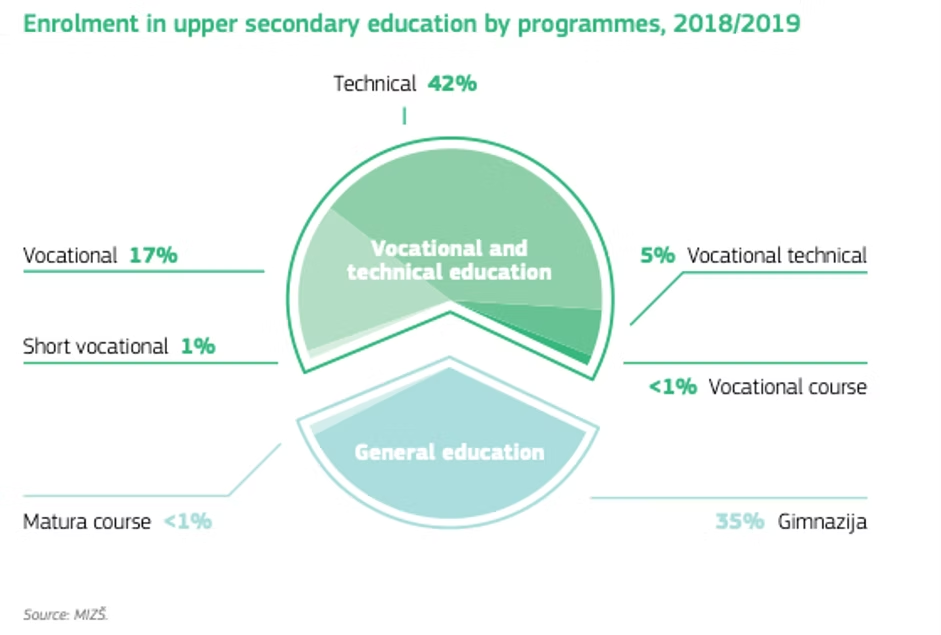
After 9 years of compulsory basic education (theoreticaly at the age of 15) students may continue to 2- to 5-year non-compulsory upper secondary education (srednja šola).
Vocational Secondary School
- Programmes focused on specific professions such as hospitality, health care, IT, technical trades and more.
- These typically last three years, with some four-year technical programmes also available.
- Students can still progress to university, and apprenticeship opportunities are expanding across the country.
Gimnazija (Grammar School)
- A four-year academic programme preparing students for university.
- It concludes with the national final examination, the Matura, required for higher education.
Higher Education
Higher education (Visokošolsko izobraževanje) institutions in Slovenia include universities, faculties, art academies and independent higher education institutions, consisting of short-cycle higher vocational education (2-year programmes) and higher education (3 or 4 years of bachelor – first cycle, 1 or 2 years of master – second cycle and 3 years of doctoral programme – third cycle, PhD).
Higher education studies are organised by both public (University of Ljubljana, University of Maribor, University of Primorska) and private universities (University of Nova Gorica), and other higher education institutions, namely at faculties, art academies, and higher vocational colleges.
International Schools in Slovenia
For families seeking an international curriculum, Slovenia offers several well-established schools, mainly in Ljubljana (7), Maribor (1) and Koper (1):
These schools serve children through primary and secondary level and provide internationally recognised qualifications (some offer as well pre-school).
Vocational Secondary School aVector International Academy (VIA)
International high school accredited by IB, Pearson Edexcel, and Slovene Ministry for Education. On-site accommodation available for IB DP students from abroad.
Curriculum: IB, IGCSE & IB DP
Age: 14-18
Yearly Fees: €14,600 – €15,750
Ljubljana International School (LIS) &Kindergarten
School offers the full continuum of the International Baccalaureate (PYP, MYP, and DP), while also providing the American International High School Diploma and the AP Capstone Diploma.
European School Ljubljana
Linguistically rich environment (Slovene and English instruction) with international recognition. Smooth transition to national systems and other European Schools in the EU.
Age: 4-18
École Française Internationale de Ljubljana
Multilingual kindergarten and school welcoming children of all nationalities since 1992. Language of instruction: French.
Age: 1-18
Yearly Fees: €5,600 – €8,000
British International School of Ljubljana (BISL)
offering traditional British education with personalized learning. Welcomes students from over 35 countries
Danila Kumar International School/Ljubljana
DKIS was founded to facilitate the lives of foreign families in Slovenia by offering two reputable International Baccalaureate programmes
Erudio International School Ljubljana
Strong academic preparation for universities worldwide. Offers IB continuum in Ljubljana.
Koper International School
Koper International School is a small British curriculum primary and secondary accredited international school
Leon Štukelj International School Maribor
Leon Štukelj International School Maribor is part of IB World Schools with an accredited PYP programme and a candidate for MYP programme.
Slovenian or International School?
Many relocating families ask which option is best.
Slovenian schools are known for strong academic standards, a safe environment and excellent extracurricular opportunities, including sports, music, cultural activities and school trips. Children who do not speak Slovene receive additional language support and typically integrate quickly.
International schools offer familiar curricula and smoother transitions for families moving between countries.
The right choice depends on your long-term plans, your child’s language skills and your family’s priorities.
Note!
Did you know?
Slovenia devotes special attention to school meals offering a menu with cooked meals and healthy snacks.
Sports in School is high level with a strong sport’s curriculum. Sports is integral to Slovenian identity.
Beginning of a new school year since WW2 starts on the 1st of September after 2 months of summer holidays.
More information
Get in touch
Expat Support
Expat consultancy, Urška Celner Gabrielse s.p.
Ljubljana, Slovenia
+386 51 673 373
info@liveinslovenia.si