Why Slovenia?
Slovenia consistently ranks highly for safety, environmental quality, work-life balance and overall quality of life. This page brings together key facts & insights as well as practical information into what makes Slovenia an increasingly attractive place to call home.
Why move to Slovenia?
In the recent years the number of foreigners moving to Slovenia has increased steadily. People choose Slovenia for much more than Lake Bled and its beautiful green landscapes. Based on conversations with expats already living here, the reasons mentioned most often are the exceptional balance between Safety & Stability, Nature & Climate Diversity, Quality of Life, and Location & Accessibility.
- One of Europe's Safest & Stabile Countries
- Nature as a way of life
- Excellent Location & Connectivity
- High Quality of Life at a Moderate Cost
- Convenient Public Transport
- Family,Pensioner, Foreigner Friendy Country
One of Europe's Safest & Stabile Countries
Safety consistently ranks among the top reasons people stay in Slovenia as it ranks among the safest countries globally according to the Global Peace Index.
Highlights include:
- among the lowest violent crime rates in Europe
- political stability
- clean tap drinking water nationwide
- very low homicide rate
- safe cities and villages
- no tropical or endemic infectious diseases
Natural disasters can occur (particularly flooding and occasional earthquakes), but overall risk remains relatively low compared with many regions of the world.
Nature as a way of life
Slovenia may be small, but its natural and geographical diversity is remarkable. With four distinct seasons and no major climate extremes, the landscape changes dramatically across the country.
Four Landscapes & Four Seasons
Slovenia brings together the Alps, the Mediterranean, the Karst and the Pannonian Plain. Within approximately two hours, you can ski in the mountains, swim in the Adriatic Sea, explore wine-growing hills or relax in thermal spas.
From hiking, skiing and cycling to swimming, camping and exploring local food and wine traditions, nature is always close by.
Four seasons are very distinctive and people in Slovenians adapt their lifestyle and activities around it. If you are used to 1 or 2 climate seasons, you will need some adaptation at the beginning to integrate into the natural and social rhythm connected to it.
One of Europe's Greenest Countries
Nature is not just something you visit in Slovenia — it is part of everyday life.
of the country is covered by forests
of Slovenia belongs to the Natura 2000 protected network, one of the highest proportions in the EU
plant and animal species have been recorded
- Access to rivers, lakes and the coast remains public
- The right to drinking water is protected by the Slovenian Constitution
Most people live just minutes away from forests, rivers, hiking trails, cycling routes, lakes or ski areas.
Nature as a Way of Life
Outdoor recreation is part of everyday life rather than something reserved for holidays. Hiking, skiing, cycling, swimming and spending time outdoors are deeply embedded in Slovenian culture and often passed down through generations.
From mountain hiking and winter sports to gardening, foraging and traditional celebrations connected to the seasons, the connection with nature remains an important part of life in Slovenia. With a relatively low population density, nature is accessible, close and, in many ways, shared by everyone.
Excellent Location & Connectivity
One of Slovenia’s greatest advantages is its size and location. Small enough to cross in a few hours, yet positioned at the crossroads of Central Europe, Slovenia puts Italy, Austria, Croatia and Hungary within easy reach.
There is a popular Slovenian joke that you can have breakfast on the slopes in the Alps, lunch by the Adriatic sea and dinner Apèro in Italy.
Approximate driving times from Ljubljana:
Italy
under 1 hour
Austria
under 1 hour
Croatia
30 minutes
Hungary
90 minutes
Adriatic coast
1 hour
Alpine ski resorts
45–90 minutes
Six international airports
within approximately 2.5 hours
From North to South, you can cross the whole Slovenia by car in 3 hours.
Major international airports nearby include: Ljubljana, Venice (two airports), Trieste, Zagreb, Vienna and Budapest.
Highway and train connections to other parts of the major international lines are well developed.
High Quality of Life at a Moderate Cost
According to OECD indicators, Slovenia performs above the OECD average in several measures of well-being, including safety, environmental quality and work-life balance.
Compared with many Western European countries, Slovenia combines:
- lower living costs
- great public infrastructure
- good work-life balance
- shorter commuting times
- clean environment
- affordable and high-quality healthcare
High-Quality Healthcare
Slovenia provides universal healthcare through a mandatory public health insurance system.
- excellent primary healthcare, highly trained medical professionals and modern health equipment in clinics and hospitals,
- one of the world's highest vaccination rates (95% for major mandatory vaccines)
- active lifestyle,
- one of Europe's safest food and drinking water systems
Private healthcare is also widely available for faster appointments and elective procedures.
Convenient Public Transport
Although many residents own a car, country has a well-developed public transport network.
- nationwide bus connections – pensioners enjoy free public transport for train and bus
- improving rail services
- affordable ticket prices
- discounted fares for students and children, free for pensioners
For international travel, extensive rail and bus connections provide easy access to neighbouring countries.
Family,Pensioner, Foreigner Friendy Country
Families often choose Slovenia because raising children is both affordable and well supported.
Benefits include:
- free public primary and secondary education (from age 6 – 18 years of age)
- generous parental leave
- numerous parks, playgrounds and sports facilities
- highly subsidised kindergarten
- child benefits for eligible residents
- very safe neighbourhoods
According to the OECD Family Database, Slovenia is among OECD countries with:
- one of the longest paid parental leave systems
- affordable childcare
- high participation of women in the workforce
Slovenia is an increasingly attractive destination for retirees looking for a safe, peaceful and active lifestyle in the heart of Europe. In 2025, Slovenia was included by Forbes among the 24 Best Places to Retire Abroad, recognising its safety, natural beauty, political stability and overall quality of life.
In addition Slovenia offers to Pensioners:
- Benefits for older residents: Residents aged 65+ can benefit from free public transport across Slovenia, including buses and trains.
- Simplified language requirements: Certain exemptions from Slovene language requirements apply to older residents, including those over 60, depending on their residence status and circumstances.
- Festival of the Third Age - Pensioner festival organised every year - More information CLICK HERE
Find out more and read my interview with two American Pensioners who moved to Slovenia few years ago.
Families often choose Slovenia because raising children is both affordable and well supported.
Benefits include:
- free public primary and secondary education (from age 6 – 18 years of age)
- generous parental leave
- numerous parks, playgrounds and sports facilities
- highly subsidised kindergarten
- child benefits for eligible residents
- very safe neighbourhoods
Property owning or renting
It is relatively easy to own or rent a a property as a foreigner. Unlike many countries, Slovenia does not impose minimum investment thresholds for purchasing residential property. There is no property tax either.
For most EU citizens and nationals of OECD countries, buying property is relatively straightforward. Rules vary depending on nationality, with additional requirements applying to certain non-EU countries.
English Is Widely Spoken, Italian and German are second foreign languages
Many Slovenians speak excellent English, particularly younger generations and professionals. Italian and German are other language well spoken, especially in border regions.
Everyday tasks such as shopping, banking, healthcare and administration are often manageable in English.
Easy Slovene Language requirements
For most third-country nationals, extending a long-term residence permit after five years generally requires demonstrating only basic Slovene language knowledge:
for most applicants
for certain family reunification cases
Applicants over 60 years of age are currently exempt from this requirement.
Interesting Facts about Slovenia
Slovenia may be one of Europe’s smaller countries, but it consistently ranks highly in quality of life, environmental protection, sport and sustainability. Here are some of the facts that make Slovenia unique.
Sports is Identity
Slovenian hike, climp, bike, own skiing and winter equipments, do extrem sports and excell in world individual and group disciplines. Slovenians are known for sporty nations, its enshrined in school curriculums, lifesytle, sports is a way of life for slovenian people.
Slovenia consistently ranks among the world’s leading countries for Olympic medals per capita.
International sports stars include:
Tadej Pogačar
4 times Tour de France winner
Primož Roglič
Luka Dončić
Janja Garnbret
‘’Majority of Slovenes own a pair of high ankle hiking shoes and walking sticks are used by all ages‘’
Built on Traditions: Foraging, Growing Food & Ana Roš
With its natural diversity and changing seasons, Slovenia offers an abundance of ingredients throughout the year. Slovenes head to the forests to forage for mushrooms, wild garlic, chestnuts, herbs, forest berries, hazelnuts, wild asparagus and much more. And what do we do with them? Come and learn! There are several courses available for english speakers as well!
When Slovenes talk about gardening, they dont mean an English od Dutch style of a garden. Most of the time they refer to growing their own vegetables and fruits – not just decorative plants and flowers. Fresh produce is also canned, preserved and stored for winter, continuing a tradition and knowledge passed down from generation to generation.
And what does Ana Roš have to do with it? A lot.
Ana Roš helped put Slovenian cuisine on the global culinary map. She was the reason Michelin stars shone in Slovenia for the first time in 2020, with her restaurant Hiša Franko receiving two Michelin stars. Named the World’s Best Female Chef in 2017, Ana Roš has built her internationally recognised cuisine around local ingredients, seasonal produce, foraging and Slovenia’s rich culinary traditions.
Today, Hiša Franko holds three Michelin stars, proving that Slovenia’s connection with nature, local food and traditional knowledge can be transformed into world-class gastronomy.
A Nation of Beekeepers
Beekeeping is deeply rooted in Slovenian culture.
registered beekeepers
bee colonies
- Among the highest numbers of beekeepers per capita worldwide
- Home of the native Carniolan honey bee, one of the world's most valued honey bee subspecies
Slovenia proposed the establishment of World Bee Day, celebrated every year on 20 May, the birthday of pioneering beekeeper Anton Janša.
Today, the President of Apimondia (the International Federation of Beekeepers’ Associations), Peter Kozmus, is Slovenian.
‘’ We eat honey all the time, we put it in tea and even on bread with butter, we bake traditional honey cookies all year around, we use honey powder for home remedies cold and soar throaght and to boose immune system, each wife will probably use propolis for kids and adults in winter months. We give a jar of honey for a gift as well, or honey products (soaps, powder for muslies, propolis,etc.) ‘’
A Country of Wine, homemade Liqueurs & Orange wine
Slovenia has over 2,400 years of winemaking tradition. Despite its small size, it is home to an extraordinary diversity of wines, with 3 wine-growing regions, 9 districts, more than 2,500 registered wine producers and around 28,000 agricultural holdings cultivating vineyards.
Wine is everywhere:
Many vineyards remain family-owned, with wine closely connected to Slovenian culture, celebrations and everyday life.
Homemade liqueurs:
Alongside wine, Slovenians have a long tradition of making homemade liqueurs and spirits from local ingredients – from herbs, berries and honey to walnuts, cherries and other fruits. Recipes are often family traditions passed down through generations.
Orange wine:
Slovenia has become particularly well known for orange wines, especially in the Primorska region, where winemakers have embraced traditional skin-contact methods. In the past two decades, Slovenian orange wines have gained international recognition and received top awards, putting Slovenia firmly on the global orange-wine map. Dont miss out on Orange Wine Festival held every April!
Many Slovenian winemakers remain small, independent and family-run – making wine here as much about tradition, place and people as it is about the bottle.
The Sound of Slovenia: Harmonika, Avsenik & Guinness Records
Music is deeply woven into Slovenian culture, with the diatonic button accordion – harmonika or “frajtonerca” – at its heart. It is a familiar feature at weddings, celebrations and festivals, and many Slovenes learn to play from a young age. The oldest accordion made in Slovenia dates back to 1892 (Source: Slovenia.si)
The Avsenik brothers made Slovenian folk music famous worldwide. Their 1955 polka “Na Golici” (Trompeten-Echo)is considered one of the most frequently played instrumental pieces in the world and has been covered more than 600 times. (Source: Slovenia.si)
Slovenian accordion players have also made their mark in the Guinness World Records. In 2023, Anže Krevh played 250 songs continuously for 53 hours, 53 minutes and 53 seconds. In 2025, accordionist and runner Anže Zavrl ran the 42 km Ljubljana Marathon while continuously playing the accordion, becoming the first person to achieve this. He continues to combine running and accordion playing at charity and sporting events.
And if you want to experience the tradition yourself, don’t miss the annual Accordion Festival in Velenje. At the 17 May 2026 event, 4,066 accordion players gathered in an attempt to set a new world record — although at least 5,500 players were needed to reach the target.
Slovenian People & Culture
Moving to Slovenia is about much more than finding a home and sorting out paperwork. It is also about understanding the people, the little everyday habits and the unwritten rules that make Slovenian life what it is. As a cultural analyst by profession, and someone who has lived abroad for many years, I find these everyday cultural differences particularly interesting. Of course, every person is different, but here are a few things you may notice when getting to know Slovenia:
Reserved at First, Loyal for Life
Slovenians can seem a little reserved when you first meet them. We usually take some time to build trust. But once you become friends, you may find that Slovenian friendships are genuine, loyal and often long-lasting.
Modesty Matters
One of the first things foreigners notice is that Slovenians are generally modest and humble people. That can sometimes work against us, as we are not very good at self-promotion. Naturally this has to do with a fact that we are a small nation and being independent only for the last 3 decades.
Family & Home
Family remains an important part of Slovenian life. In many places on the country side a Sunday lunch starts at 12:00 with a traditional beef soup, grandparents helping with grandchildren, gardening and working on the house are still very much part of everyday life. Slovenians on the countryside own large plots and big houses that are usually split to different floors housing three generations under one roof.
“Let's Have a Coffee”
If a Slovenian asks you to “go for a coffee” (Gres na kavo?/ Greva na kufe?), means in other words to meet and have anytime of drink. Don’t expect a five-minute espresso. Coffee is a social ritual — an excuse to sit down, talk and catch up. And an hour can easily become two! If at home, a plate of home made cookies will be placed on the table and you are expected to self-service more than one cookie.
Hospitality & Home Etiquette
Once you are invited into a Slovenian home, you will usually experience our hospitality at its best. Bringing a small gift such as wine, coffee or sweets is appreciated — and taking your shoes off and putting on slippers at the door is almost a must!
Food, Traditions & Local Pride
Slovenian culture is closely connected to food, seasons and traditions. Christmas and Easter customs, Carnival, St. Martin’s Day, village festivals, beekeeping and folk music are still very much alive. And don’t be surprised if someone tells you they are not simply from Slovenia, but specifically from Štajerska, Primorska, Dolenjska or their home town or village. Local identity runs deep here.
Getting to know these small cultural details can make your experience of living in Slovenia much richer — and perhaps help you understand why we Slovenians do things the way we do.
Communication style
Slovenians usually communicate politely and directly ( Cultural relativism: Not as direct as the Dutch but not as indirect as Asian cultures).
- avoid exaggeration
- value honesty over excessive enthusiasm
- separate professional and private relationships
- appreciate competence more than self-promotion
- give feedback first negative then positive - all down to earth
A useful note for foreigners
Slovenians generally value authenticity over status. Being reliable, respectful and willing to participate in local community life is often appreciated more than professional titles or displays of wealth. Internationally known antropologiest dr prof. Vesna Vuk Godina argues in her work, many social norms in Slovenia still reflect the country’s long history of small, cooperative communities where trust and reciprocity were essential.
Practical information
Emergency number (s)
is the general emergency number for ambulance, fire and rescue services.
is the police emergency number.
Child health emergency from 19:00-7:00 up to age the 16 years in Ljubljana region (each town has different rules, check out in your local town).
Time Zone & Country Code
Slovenia uses Central European Time (CET- +1 from UTC) in winter and Central European Summer Time (CEST) from late March to late October.
Country code: +386
Drinking Tap water
Slovenia has excellent-quality drinking water (protected by the constitution). Tap water is safe to drink in most households and public drinking taps (unless stated otherwise), so there is no need to buy bottled water.
Public transport
Slovenia offers a good network of buses throughout the whole Slovenia. Train runs through major cities and towns.
Buses: Arriva , Bus station Ljubljana
Public, international and airport transfers: Nomago
Trains: Slovenske Železnice, OEBB Austrian
Free public transport is available to eligible residents aged 65+.
Driving
- Slovenia drives on the right-hand side.
- Seat belts are compulsory and headlights must be on during the day.
- Changing winter/summer tires is also compulsory by law (March and November).
- Motorways require a vignette (e-vinjeta).
Electricity
- Slovenia uses 230 V
- 50 Hz electricity and standard European two-pin plugs (Type C/F)
- Electric charging stations for cars - Type 2 /CCS
- Number of stations 3050+ and growing -See the map GremoNaElektriko
Payments
Slovenia uses the euro (€). Cards and contactless payments are widely accepted, although carrying some cash is useful and advisable in smaller businesses, markets and rural areas.
Sunday shopping
Most shops and supermarkets are closed on Sundays and public holidays. Exceptions include some petrol stations, smaller family-run shops and certain farm shops.
Tipping
Tipping is not compulsory, but leaving around 5–10% for good service is increasingly common in restaurants and cafés. Some services also offer tipping by the card, not only cash, although cash is still broadly considered.
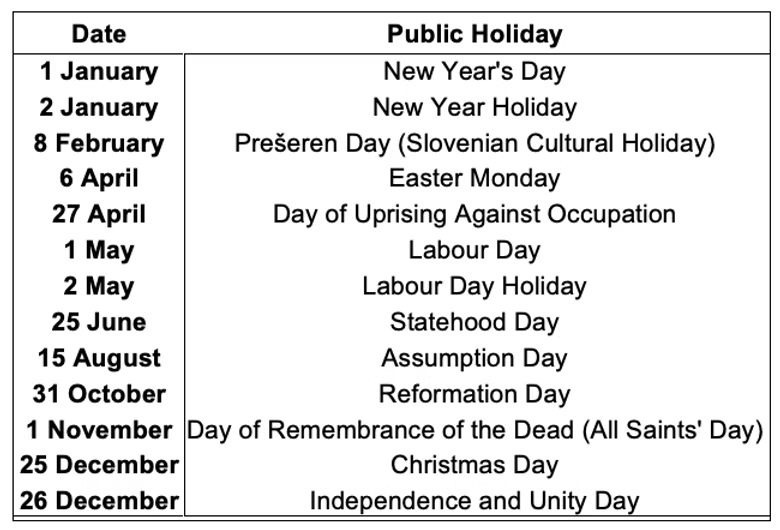
Public Holidays
Slovenia has 13 fixed public holidays each year and Easter Monday, which varies by year. Most businesses, banks, schools and kindergartens and public offices are closed on these days, although restaurants, tourist attractions and some retail stores may remain open.
Did you know?
Human Development Index
Combining health, education and living standards.Safety& Peace
Source: UNDP HDI report 2026
in 2024 and energy production 33% from Hydro power
Source: IEA and European Environmental Agency
Get in touch
Expat Support
consultancy, Urška Celner Gabrielse s.p.
Ljubljana, Slovenia
+386 51 673 373
info@liveinslovenia.si